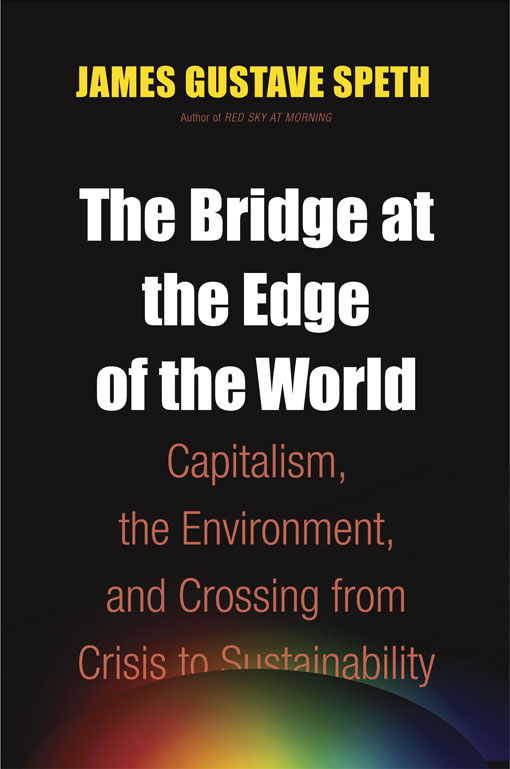
The Bridge at the End of the World

The Bridge at the End of the World

The Bridge at the End of the World
James Gustave Speth.
At the end of his career as a litigator, academic and veritable environmental prophet, Gus Speth has reached a disturbing conclusion: “All we have to do to ruin the planet is to keep doing exactly what we’re doing today.” The environmental movement, he argues, is swimming upstream – limited by our cloistered approach to change and a failure to address the systemic failures of a myopic economic system. Passing the torch to the next generation, he offers a thoughtful analysis of these systemic challenges and outlines the necessary steps for transformative change. The Bridge at the Edge of the World is essential reading for those preparing to make the crossing. Continue reading The Bridge at the End of the World

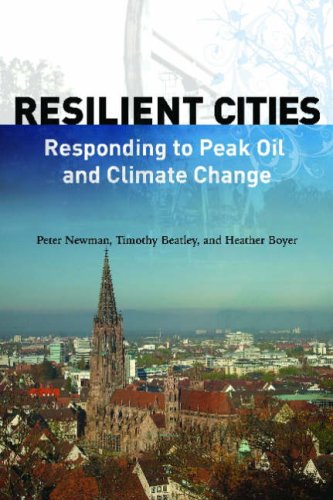
Resilient Cities: Responding to Peak Oil and Climate Change

Resilient Cities: Responding to Peak Oil and Climate Change

Resilient Cities: Responding to Peak Oil and Climate Change
Peter Newman, Timothy Beatley and Heather Boyer, Washington, DC: Island Press, 2009, 166 pages.

Yogi Berra’s famous line, “The future ain’t what it used to be,” certainly rings true for decision makers and citizens concerned with the well-being of urban areas.

Resilient Cities, written by sustainability researchers Peter Newman, Timothy Beatley and Heather Boyer, describes a future in which peak oil and climate change will mean the end of many familiar signs of affluence. We will have to give up urban sprawl, transportation systems organized around personal motor vehicles, our dependence on global trade (especially in food) and, more generally, our ability … [Click here to read more!] Continue reading Resilient Cities: Responding to Peak Oil and Climate Change

Some Like It Cold: The Politics of Climate Change in Canada

Climate change, climate forcing, global warming – all these terms frame a collective public debate about the future of the world as we know it. Since that “world” is dynamic and geographically diverse, it is not surprising that political responses range widely from hand-wringing to commitment and resignation, to disbelief and reticence, or even outright denial. Continue reading Some Like It Cold: The Politics of Climate Change in Canada

Why We Disagree About Climate Change + Our Choice: A Plan to Solve the Climate Crisis

Why We Disagree About Climate Change
Mike Hulme, Cambridge University Press; New York, 2009, 363 pages.

Our Choice: A Plan to Solve the Climate Crisis
Al Gore, Rodale Press; New York, 2009, 405 pages.

If we can’t agree about Climate Change, how can we possibly address the issues in time to prevent disaster?

Four decades of scientific study, unilateral government discussions and international collaboration, and here we sit with very little action to show for it. The question of why we can’t agree is therefore one of the most important questions of our age. University of East Anglia climate change professor Mike Hulme offers a valuable explanation in his recent book Why we Disagree About Climate Change. He tells us it’s in the capital letters.

Scientific data about anthropogenic climate change: temperature rise, ice melt, impacts on ocean salinity and acidity, weather patterns and species loss fall into a largely uncontested category designated with a small “c.” But Hulme tells us that the problem of human response and cooperation resides in the big “C” of Climate Change; the social interpretation of those bare, irrefutable facts.

Once we enter the social sphere we find a vast territory peopled with cultural, experiential and linguistic differences as great as those of the physical planet. Choose any cultural lens: politics, … [Click here to read more!] Continue reading Why We Disagree About Climate Change + Our Choice: A Plan to Solve the Climate Crisis

Storms of My Grandchildren: The Truth About the Coming Climate Catastrophe And Our Last Chance to Save Humanity

Storms of My Grandchildren: The Truth About the Coming Climate Catastrophe And Our Last Chance to Save Humanity
James Hansen, New York: Bloomsbury, 2009, 320 pages.

It’s odd. At 68, James Hansen, arguably the planet’s most renowned climatologist and one of the earliest prophets of human-induced global climate change, has finally published his first book.
“Odd” is a fitting description for the book as well.

Storms of My Grandchildren is an expansive treatise on the perils of increased carbon dioxide emissions, juxtaposed with anecdotes of Hansen’s meetings with the likes of Dick Cheney and his Climate Task Force, … [Click here to read more!] Continue reading Storms of My Grandchildren: The Truth About the Coming Climate Catastrophe And Our Last Chance to Save Humanity

The Transition Handbook: From Oil Dependency to Local Resilience

The Transition Handbook: From Oil Dependency to Local Resilience
Rob Hopkins
White River Junction, Vermont: Chelsea Green Publishing Company, 2008, 240 pages.

At last, here is a book about our common future that we don’t have to be afraid to read. Written by “transition movement” founder Rob Hopkins, The Transition Handbook offers an inspiring and practical blueprint for community-based action in response to the challenges of climate change and … [Click here to read more!] Continue reading The Transition Handbook: From Oil Dependency to Local Resilience

Climate Wars + Global Warring

Climate Wars + Global Warring

Climate Wars
Gwynne Dyer
Toronto: Random House, Canada, 2008, 288 pages.

Global Warring
Cleo Paskal
Toronto: Key Porter Books, 2009, 288 pages.

Here’s a fact I had never considered: the word “rival” comes from the Latin word rivalis, meaning “those who draw water from the same source.” Rivalry is closely related to the availability of shared resources, and tensions are easily triggered when food and water are at stake.

Now, let’s take this to the extreme: climate change projections suggest that the flow of  many of the world’s major rivers will be seriously reduced as glaciers retreat. The scale of potential conflict is staggering. The Himalayan watershed alone, which includes the Ganges, Indus, Yangtze and Mekong Rivers, supplies water to almost half the people on this planet, including nuclear powers China, India and Pakistan.

But this is about more than rivers. Two new books on the issue, Climate Wars and Global Warring, introduce a bevy of reasons for concern: natural disasters, disappearing low-lying island states, shifting coasts and access to oceanic exploitation zones, the melting Northwest Passage, desertification and altered patterns of food production. Each has the potential to redefine how we interpret and conceptualize international law, how we interact diplomatically with other nations, and how and why we engage militarily.

Cleo Paskal, a fellow at Chatham House who boasts journalistic stints at The Economist and the Chicago Tribune, seeks to “introduce and legitimize the idea that environmental change is about to have enormous, and specific, geopolitical consequences.”…[Click here to read more!] Continue reading Climate Wars + Global Warring

It’s “Now or Never” to Avert Climate Catastrophe

Now or Never
Tim Flannery
Toronto ON: Harpercollins Canada 2009

In the 1970s, the environmental movement was regularly criticized for being too negative, and providing too little emphasis on positive solutions. Or, they were simply dismissed as “chicken little” radicals. These early criticisms ushered in several years of hushed tones and muted pessimism.

These days, as the world’s ecological and climate woes continue to worsen, there seems to be a little more straight talk from the green corner. The reason is hardly worth mentioning, but here goes. While ecological destruction throughout the… [Click here to read more!] Continue reading It’s “Now or Never” to Avert Climate Catastrophe

A Physicist’s Plea For The Environment

Terracide
Hubert Reeves, translated by Donald Winkler
Toronto, ON: Cormorant Books Inc. 2008, 200 pages

Hubert Reeves was born in Montreal, but is a household name in France, where he once directed a national research centre and appears regularly on television. He is one of many scientists (an astrophysicist, to be precise) who has switched gears recently in order to sound the alarm about climate change. His most recent publication, Terracide, was first written in French (Mal de Terre) in 2003, but has been updated for this newer translation in English.

Reeves’ overview of our ongoing environmental crises may seem a little over-generalized to some readers… [Click here to read more!] Continue reading A Physicist’s Plea For The Environment