Break Through: From the Death of Environmentalism to the Politics of Possibility + The Landscape of Reform: Civic Pragmatism and Environmental Thought in America

In 2004, the essay “The Death of Environmentalism: Global Warming Politics in a Post-Environmental World,” rocked the environmental community. Continue reading Break Through: From the Death of Environmentalism to the Politics of Possibility + The Landscape of Reform: Civic Pragmatism and Environmental Thought in America

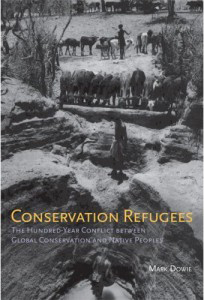
Conservation Refugees: The Hundred-Year Conflict between Global Conservation and Native Peoples

Conservation Refugees: The Hundred-Year Conflict between Global Conservation and Native Peoples

Conservation Refugees: The Hundred-Year Conflict between Global Conservation and Native Peoples
Mark Dowie, Cambridge, MA: The MIT Press, 2009, 336 pages.

Over the last century, millions of indigenous people around the world have been evicted from their traditional lands in the interests of conservation. Many have been reduced to poaching and trespassing on their ancestral land, or “assimilated” into chronic poverty. The good news is that native people are beginning to shift the global conservation agenda to one that treats them fairly. In Conservation Refugees, investigative journalist Mark Dowie makes a compelling argument for people-centred conservation that recognizes native people as central to protecting biological diversity. Rich in rarely published details from every corner of the Earth, this is an important book for students of conservation, international development and native cultures. Continue reading Conservation Refugees: The Hundred-Year Conflict between Global Conservation and Native Peoples

Water on Table

Canadian crusader Maude Barlow, the National Chair of the citizen advocacy group The Council Of Canadians, has had to defend the life-or-death truth against corporate interests for years… And even today, it is a war un-won. Continue reading Water on Table

Why We Disagree About Climate Change + Our Choice: A Plan to Solve the Climate Crisis

Why We Disagree About Climate Change
Mike Hulme, Cambridge University Press; New York, 2009, 363 pages.

Our Choice: A Plan to Solve the Climate Crisis
Al Gore, Rodale Press; New York, 2009, 405 pages.

If we can’t agree about Climate Change, how can we possibly address the issues in time to prevent disaster?

Four decades of scientific study, unilateral government discussions and international collaboration, and here we sit with very little action to show for it. The question of why we can’t agree is therefore one of the most important questions of our age. University of East Anglia climate change professor Mike Hulme offers a valuable explanation in his recent book Why we Disagree About Climate Change. He tells us it’s in the capital letters.

Scientific data about anthropogenic climate change: temperature rise, ice melt, impacts on ocean salinity and acidity, weather patterns and species loss fall into a largely uncontested category designated with a small “c.” But Hulme tells us that the problem of human response and cooperation resides in the big “C” of Climate Change; the social interpretation of those bare, irrefutable facts.

Once we enter the social sphere we find a vast territory peopled with cultural, experiential and linguistic differences as great as those of the physical planet. Choose any cultural lens: politics, … [Click here to read more!] Continue reading Why We Disagree About Climate Change + Our Choice: A Plan to Solve the Climate Crisis

Open Wide a Wilderness

Open Wide a Wilderness
Nancy Holmes ed., Waterloo: Wilfrid Laurier University Press, 2009, 510 pages.

Nancy Holmes, a professor in the Faculty of Creative and Critical Studies at the University of British Columbia Okanagan, is to be congratulated for this plump and sumptuous anthology of English language Canadian nature poetry.

In Open Wide a Wilderness, two centuries of poetry by over 190 poets are assembled in only 510 pages. Although it enjoys little mainstream attention, Canadian poetry is strewn throughout the myriad inconspicuous little seeps and rivulets that feed the watersheds nourishing our national literary culture. It’s found in the colourful archipelago of small presses across Canada (including Turnstone, … [Click here to read more!] Continue reading Open Wide a Wilderness

Storms of My Grandchildren: The Truth About the Coming Climate Catastrophe And Our Last Chance to Save Humanity

Storms of My Grandchildren: The Truth About the Coming Climate Catastrophe And Our Last Chance to Save Humanity
James Hansen, New York: Bloomsbury, 2009, 320 pages.

It’s odd. At 68, James Hansen, arguably the planet’s most renowned climatologist and one of the earliest prophets of human-induced global climate change, has finally published his first book.
“Odd” is a fitting description for the book as well.

Storms of My Grandchildren is an expansive treatise on the perils of increased carbon dioxide emissions, juxtaposed with anecdotes of Hansen’s meetings with the likes of Dick Cheney and his Climate Task Force, … [Click here to read more!] Continue reading Storms of My Grandchildren: The Truth About the Coming Climate Catastrophe And Our Last Chance to Save Humanity

The Water Softener: Interview with David Brooks

David Brooks tells how the soft path strategy makes the most of the water we have.

Satisfying the world’s growing demand for clean water is a monumental challenge. With water supply infrastructure now stretched to the limit, editors David Brooks, Oliver Brandes and Stephen Gurman offer a new management approach in Making the Most of the Water We Have. Based on energy’s proven soft path strategy, the book goes far beyond touting water efficiency: it points the way toward decreasing worldwide demand for this precious resource and shows how we can save money getting there.

Kurtis Elton, one of the book’s many contributors, recently met with David Brooks for some background on this strategy as it begins to gain steam.
[Read the full interview] Continue reading The Water Softener: Interview with David Brooks